

When thinking about World War I, people often think about the politics of the battles, yet people rarely ever imagine what life would have been like on the home front.
Guildford, like many other towns at the start of the war, experienced a surge of patriotism at a scale that cannot be imagined in today’s world. Around 4000 men from the town signed up to fight, which in today’s numbers may not sound much, but the population of Guildford at the time was only around 25,000. With 32% of the male population suddenly leaving, the atmosphere of the town completely changed. Nearly every family would have the father, as well as many of the sons leave, uncertain whether they would ever meet each other again. In today’s world, one can hardly imagine what it would be like to have a third of the male population suddenly depart. It meant families felt empty, full of worry for whether their sons, husbands, fathers or brothers would ever return. For most, that is an impossible thing to even consider.
Today, many do not know about the Zeppelin raid that took place here in October 1915. Zeppelins were some of the first bomber planes to be developed, and being present in a bombing would have been terrifying to witness. Despite being 250m long, they were nearly invisible at night due to their charcoal colouring. Considering planes themselves were still a new phenomenon during the 1910s, one could only imagine the horrors faced by the citizens who were present for the attack. Destruction of an English town during war was far out of living memory by then, with the last attack on English soil being during the 1660s, 250 years before the First World War. With Hampton being the initial target, a missed turn caused the Zeppelin to follow the River Wey by mistake. The raid itself consisted of 12 bombs, hitting locations such as the road going uphill by the main train station, as well as farmland, which still dominated the outskirts of Guildford.
Some of this war damage can still be seen today. By walking down the towpath of the River Wey, twenty feet of the wall along the side of the path is absent, due to one of the bombs that landed in that precise spot. Mercifully, the only casualties were 17 chickens, and Guildford is lucky to be among the towns which only suffered from one raid.
It is also key to remember, that the Guildford of then is not the Guildford of today. Factories littered the town, most of which contributed to the war effort. The most significant of these was Dennis Brothers’ Limited, which operated two factories within the town, one on Woodridge Road, near today’s business park, and one on Bridge Street, on the row of buildings where the Tesco is today when on route to the station. These factories produced vehicle chassis for the war effort.
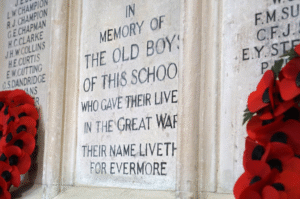
While the vast majority of soldiers did return home, a considerable number did not. 440 of the 4000 soldiers who fought never returned home, 58 of those being old Guildfordians, with some as young as 19. Boys like us, who were in the same position as us, and faced the same experiences as us fought in those trenches. An additional 150 Old Guildfordians faced life-changing injuries from the war, whether that be blindness from a gas attack, or a missing leg from a grenade.
In remembering these sacrifices of not just this school, but from Guildford as a whole, from the men who enlisted to the workers in the factories, we remember a community who sacrificed their livelihoods to help defend not only their families, but their country.
Written and Delivered by Sebastian Cunningham at our Remembrance Service