
 In early May the Lower Sixth biologists woke up bright and early to travel to Dale for the famously celebrated Bioliday. We departed bright and early in the morning from G Live by coach and arrived in Pembrokeshire around lunchtime.
On our first day we visited Jetty Beach where our guide introduced us to the rocky shore ecosystem and taught us about zonation. We learnt and revised key factors which affect zonation such as abiotic, biotic and competition. We also carried out fieldwork on the top shell (marine snail) distribution across the shore using stratified sampling involving quadrats and the identification of top shells present within each quadrat. After totalling every group’s readings, we analysed our results using the chi-squared test to identify any emerging patterns.
On Saturday, our main focus was to devise an investigation to test for the abundance change in response to environmental conditions. We each used different sampling techniques and investigate how species distribution changes in response to a variety of environmental factors.
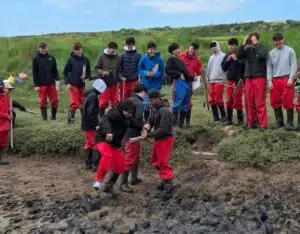
On Sunday, we all visited the Gann saltmarsh where we studied succession. We used dichotomous keys and point quadrats to identify plant species and measure the biodiversity of the saltmarsh. The data collected was totalled and used to find the Spearman’s rank correlation coefficient to uncover the relationships in species distribution during the different stages of succession.
On our final day, we conducted a crabbing investigation on Dale Pontoon where we caught 24 crabs and marked them each of them. We took a short break to allow the crabs we caught to mix evenly with the rest of the crab population. Once we began our second round of crabbing, we captured 30 crabs of which we recaptured 2 crabs who were marked. Using the Lincoln Index, we could safely estimate the total population size under the Dale Pontoon to be around 360.
Looking back at this past year, this trip was the most hands-on experience we have enjoyed. The opportunity to learn new things outside of the classroom is what really set this trip apart from lessons and made the knowledge ‘click’ and enhanced our classroom learning. The application of knowledge in a real-world setting helped us develop confidence in ecological fieldwork, methods and data analysis.
Lower Sixth Biology Student